
A brief introductory note to
Smart Contract Use in Geopolitics
written by Klemen Skornisek
Original post: March 8th 2023
Last edit: April 17th 2023
Let’s take a short, introductory look into how blockchain based smart contracts might one day be used in geopolitical applications by examining the case of denuclearization negotiations between the United States of America and the Democratic People’s Republic of Korea (North Korea) within the extended context of the disintegration of the Joint Comprehensive Plan of Action (Iran Nuclear Deal).
Important Disclaimer:
Please understand that I published this content prematurely due to uncertainty regarding further development and even my personal safety / livelihood / well - being due to the sensitive nature of this topic. As such this content is not fully developed and may be flawed. Further research, review, debate and education are critically necessary; I plan on amending this content with improvements over time, however it is difficult… Despite its importance, there is a lack of support, communication, collaboration, resources and enthusiasm over this work. Lastly, note that due to the sensitive nature of this content, I am engaged in self-censorship, which leads to routine miscommunication and misinterpretation due to natural human psychology and nature. Note that even if we are all slightly different, in the absence of circumstance we are all the same in the grand scheme of things; I love, understand and accept you all (even if I fail to show it sometimes).
(add executive summary section & video exec. summ. section)
Iran Nuclear Deal (Briefly)
The Iran Nuclear Deal (Joint Comprehensive Plan of Action) was a complex, one of a kind, pioneering agreement negotiated between the Islamic Republic of Iran and P 5+1 countries (the five permanent members on the United Nations Security Council: United States, China, Russia, United Kingdom, France + Germany & the European Union).
Trying to prevent nuclear weaponization, the agreement limited and monitored Iran’s nuclear research & development activity in exchange for economic sanctions relief. Under the pioneering agreement, the International Atomic Energy Agency deployed innovative “don’t trust - verify” nuclear monitoring / enforcement technologies and techniques intended to verifiably ensure Iran abides by the agreement, and does not produce nuclear weapons during its duration.
President Obama’s administration represented the United States in the initial negotiations, however, the Iran Nuclear Deal was domestically controversial; certain groups and individuals called Iran’s compliance into question and criticized the agreement as fundamentally flawed. Once President Trump's administration took power, the new president decided he would not re-certify Iran’s compliance. Furthermore, President Trump ultimately reinstated economic sanctions through a Presidential Memorandum which finally led to the United States’s official withdrawal.
Despite European, Chinese and Russian continued support of the agreement coupled with the International Atomic Energy Agency’s certification that Iran was (at the time) complying with the JCPOA, the reinstated US sanctions were discouraging economic activity to such a degree that the deal mostly disintegrated in practice, resulting in Iran’s stop in compliance.
DPRK Denuclearization Negotiations (Briefly*)
The world had paid a close attention to the Iran Nuclear Deal debacle. This instance of instability had raised questions about the United States Government’s capability of making and abiding by similar long-term agreements in the future.
Since many qualified expert parties saw the Joint Comprehensive Plan of Action as effective, and Iran as compliant (note that the author of this article has no native opinion or expertise on this particular topic) the United States’s withdrawal had likely significantly influenced the denuclearization negotiations between President Trump's administration and the Government of the Democratic People's Republic of Korea (North Korea):
Issue 1:
According to John Bolton's accounts in 'The Room Where it Happened' certain key decision making individuals within President Trump's administration initially insisted the DPRK provides a full account of their nuclear capabilities, facilities, stockpile etc. as a prerequisite to starting any concrete denuclearization discussions.
I imagine the DPRK viewed this prerequesite as a somewhat ridiculous request considering future US administrations could disintegrate any deal the current administration agrees to with little consequence. In contrast to this reality, the sensitive national security information the DPRK would release would be public forever, putting the DPRK in a situation where they were pressured to release highly sensitive national security information in return for basically nothing before concrete negotiations even begun. On the other hand, John Bolton also had a most valid point - that without such a list it would be impossible to verify denuclearization has indeed occured and the DPRK would indeed be compliant with a hypothetical deal.
Issue 2:
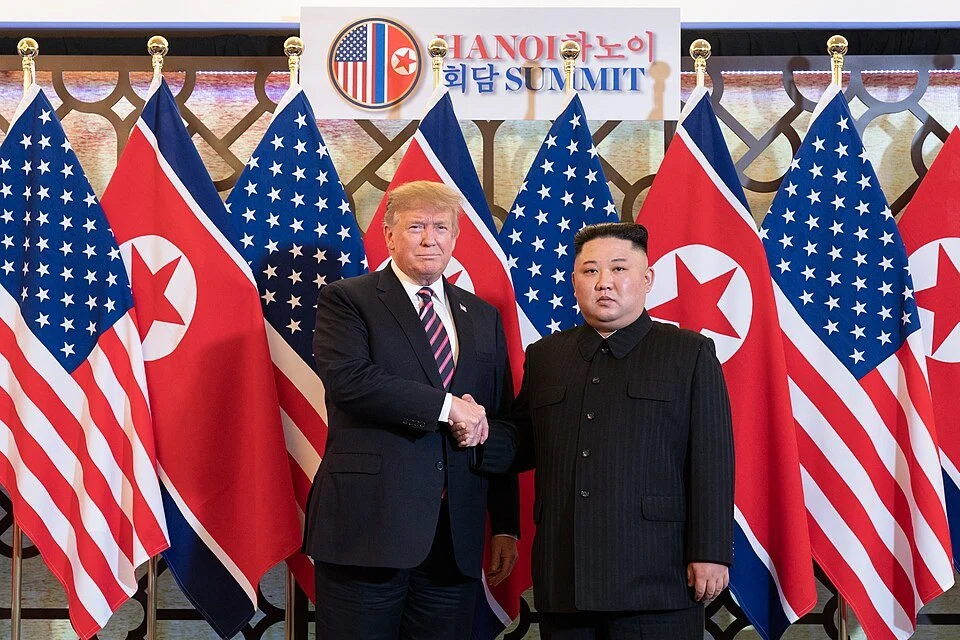
After a little back and forth, give and take; US - DPRK denuclearization negotiations finally stalled in Hanoi because President Trump refused** the DPRK (North Korea)’s offer to dismantle Yongbyong (the DPRK’s primary Nuclear Complex) in return for partial sanctions relief - the five out of eleven United Nations sanctions placed on the DPRK (North Korea) between 2016 and 2017).
*note: I omitted a lot of important background and context information about the Trump era USA - DPRK nuclear negotiations because this article is intended for a blockchain audience. For more important information about specifically the USA - DPRK denuclearization negotiations please contact me here.
** I personally presume this otherwise arguably reasonable first step disintegrated due to the United States’s domestic instability where marketing such a deal to the domestic audience is impossible due to extreme partisanship where essentially anything the other side does is automatically criticized (oftentimes irrationally).
Let’s look at how blockchain based smart contracts could aid in this particular situation:
Blockchain Based Smart Contracts
Note: This article assumes you have a certain degree of knowledge and understanding of decentralized blockchain technology. If you don’t, reach out to me here and I’ll walk you through the prerequisites (full KYC identification required).
A Brief Comment on Reputation:
Blockchain technology and smart contracts have been validly criticized [see Molly White’s Blockchain Solutionism Lecture, Is Web3 Bullshit ? and Predatory Community]. The controversial, poorly understood, unregulated technology is oftentimes over - hyped and criminally abused by less than stellar individuals.
However, despite the technology’s controversies, legitimate real world use cases of substantial value can be envisioned once the technology properly matures. Geopolitics presents us with one such use case:
Let’s briefly look at how blockchain based smart contracts could aid the US - DPRK denuclearization negotiations:
We have multiple hostile parties who do not trust each other since they have been at war for over 70 years,
We have multiple parties all of which are not trustworthy by any stretch of the imagination,
We have multiple parties who take a substantially differing view on and approach to substantial issues,
We have multiple parties in a situation where game theory suggests empathy, tolerance and cooperation would be most mutually beneficial for everyone ( in alternative to world changing nuclear war; cessation of hostilities would result in: increased world security, a likely improvement in human rights status of all participants, improvement in relations, increase in cooperation, worldwide benefits due to simple laws of economic specialization, supply and demand etc. ).
Properties of Blockchain Based Smart Contracts:
A public blockchain based smart contract platform is in essence a computer program that holds a publicly accessible, interactive database which is dispersed over computers all over the world, where each computer verifiably holds the exact same copy of the database in a decentralized, censorship - resistant manner.
The database can hold not only financial transaction information (Bitcoin), but even computer code where decentralization’s ensuing censorship resistance guarantees execution of code, or in other words: code immutability.
These properties enable the minimization of trust.
Negotiating parties do not need to trust each other once the immutable code is uploaded onto the blockchain, because on a sufficiently decentralized blockchain, or network of blockchains* there is no central force that can prevent the code from executing.
Through guaranteed execution of immutable, unalterable financial code: facilitation of novel, never before possible geopolitical tools such as the following are possible:
*achieving sufficient decentralization through cross - chain deployment - writing coming soon; until then - see Axelar
A Hypothetical Denuclearization Smart Contract
For this example, we will rely on the work of Stanford’s Siegfried S. Hecker, Robert L. Carlin, and Elliot A. Serbin’s research:
Example Walkthrough:
To properly illustrate the geopolitical use of blockchain based smart contracts, we’ll set up a fantasy scenario where the DPRK (North Korea) agrees to relinquish their nuclear weapons program in return for financial reparations from Japan for their colonial exploitation, from the United States for the war crimes (against humanity) the US committed during the Korean War, alongside financial and development assistance in return for future investment opportunities and market exposure from other relevant countries, all done over a prolonged period of time which would allow the DPRK’s proper national security assurance, development and re-integration with the world at a reasonable, secure, comfortable pace.
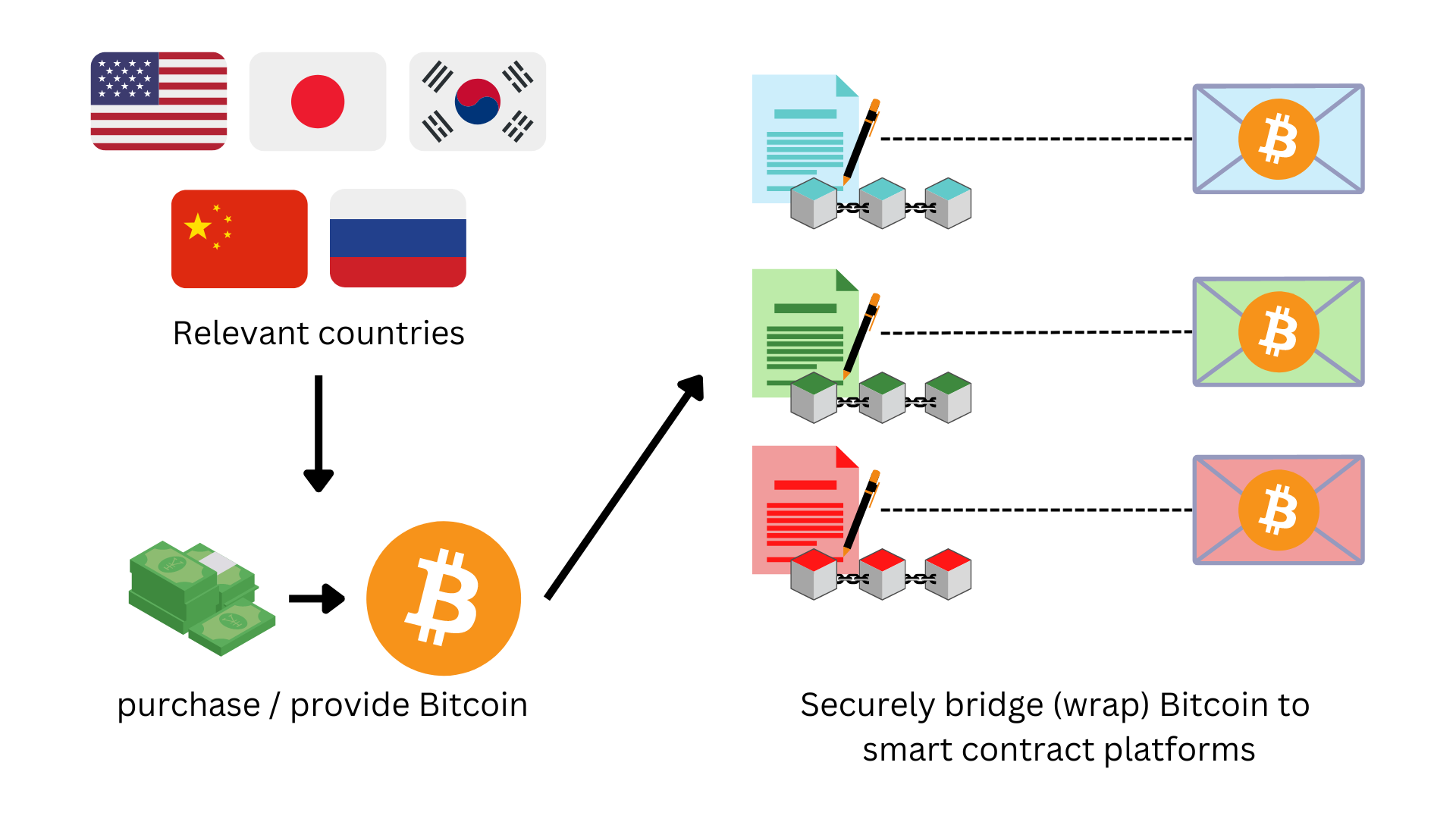
In the first phase we will assume: 1) Bitcoin is sufficiently adopted, understood and used as a stable store of value with sufficient liquidity & infrastructure, 2) bridges between blockchains have reached sufficient security and trust.
Those familiar with blockchain tech / cryptocurrency will already understand why I chose bitcoin as geopolitical tender. For those who don't know (short and sweet): countries are adopting Bitcoin; Bitcoin’s fixed monetary policy negates the effects of inflation; once mature Bitcoin should be stable, decentralized and secure enough to facilitate geopolitical use.
Note: If you’re wondering why bridge Bitcoin to multiple smart contract platforms: see sufficient decentralization annex (when finished).
Phase I (issue 1)
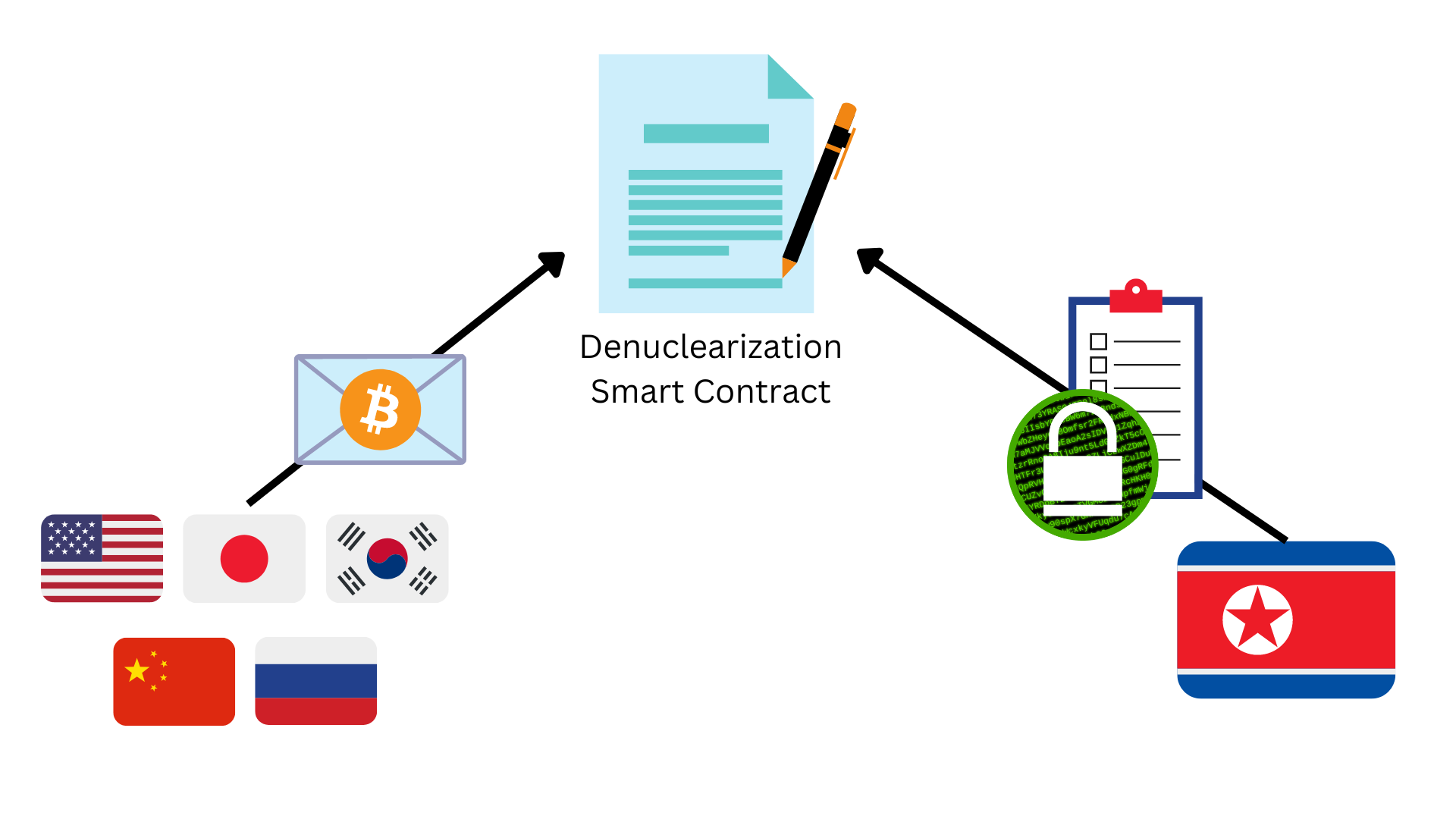
Countries deposit bridged / wrapped Bitcoin into the Denuclearization Smart Contract, which is immutably pre - programmed to execute a certain way (see below).
On the other side of the deal, the DPRK compiles a full list of all publicly known and unknown nuclear weapons capabilities, facilities, stockpile etc. as demanded by John Bolton et. al., encrypts it part by part and deposits it in the Denuclearization Smart Contract.
The smart contract is programmed in the following way:
How can we satisfy the skeptics who will claim that the DPRK (North Korea) will lie and cheat when it comes to the list ?
The full encryption of the list should satisfy the DPRK’s national security concerns. If the DPRK does not release the keys which enable decryption, the list is never public.
Crucial to understand: The bridged / wrapped Bitcoin tokens are a smart contract itself, which can be programmed with "freeze funds," or / and "transfer from" functions in the same manner as Tomorrow Tree's Sanctions Compliance Cryptocurrency System is, regardless of where the bridged / wrapped Bitcoin tokens are transferred to.
These functions will allow external control of the bridged / wrapped Bitcoin in the extreme case the DPRK is found to be verifiably non - compliant. External control of the bridged / wrapped Bitcoin tokens could be assigned to the United Nations Security Council or even the global public (direct - democracy style).
Such a system creates an incentive for good behavior from the very beginning of negotiations; combined with the approach described in the following sections I will argue the DPRK has much higher incentive for good behavior, with the cost of mis - behavior being too great.
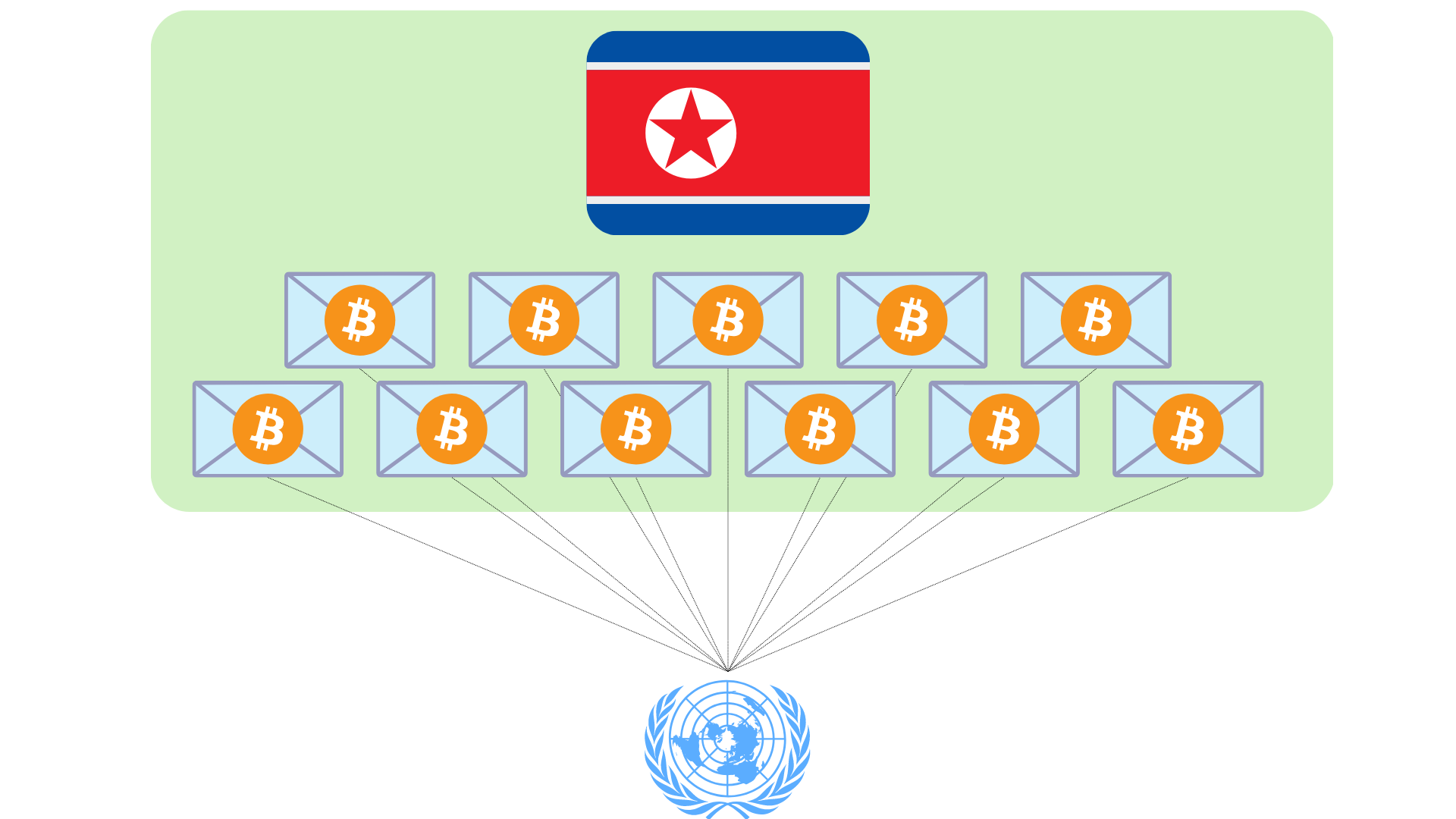
The DPRK (North Korea) fully owns the bridged / wrapped Bitcoin, which can be used, but there exists a fail safe for extreme cases to disincentivize bad behavior.
Alternatively, a smart contract could also be programmed in such a way where external events (such as security guarantees or destructions of facilities) could release encryption keys - but this idea is somewhat confusing and not yet developed sufficiently, so lets leave it for now.
How would these bridged / wrapped Bitcoin tokens be used ?
The DPRK could use them as a reserve currency, a way to back up their national currency, as loan collateral, as an investable asset, or keep them as strategic reserves.
There could be a set limit for how long the tokens remain bridged / wrapped (let's say for example: 50 years) before they could be bridged / unwrapped back into uncontrolled, native Bitcoin.
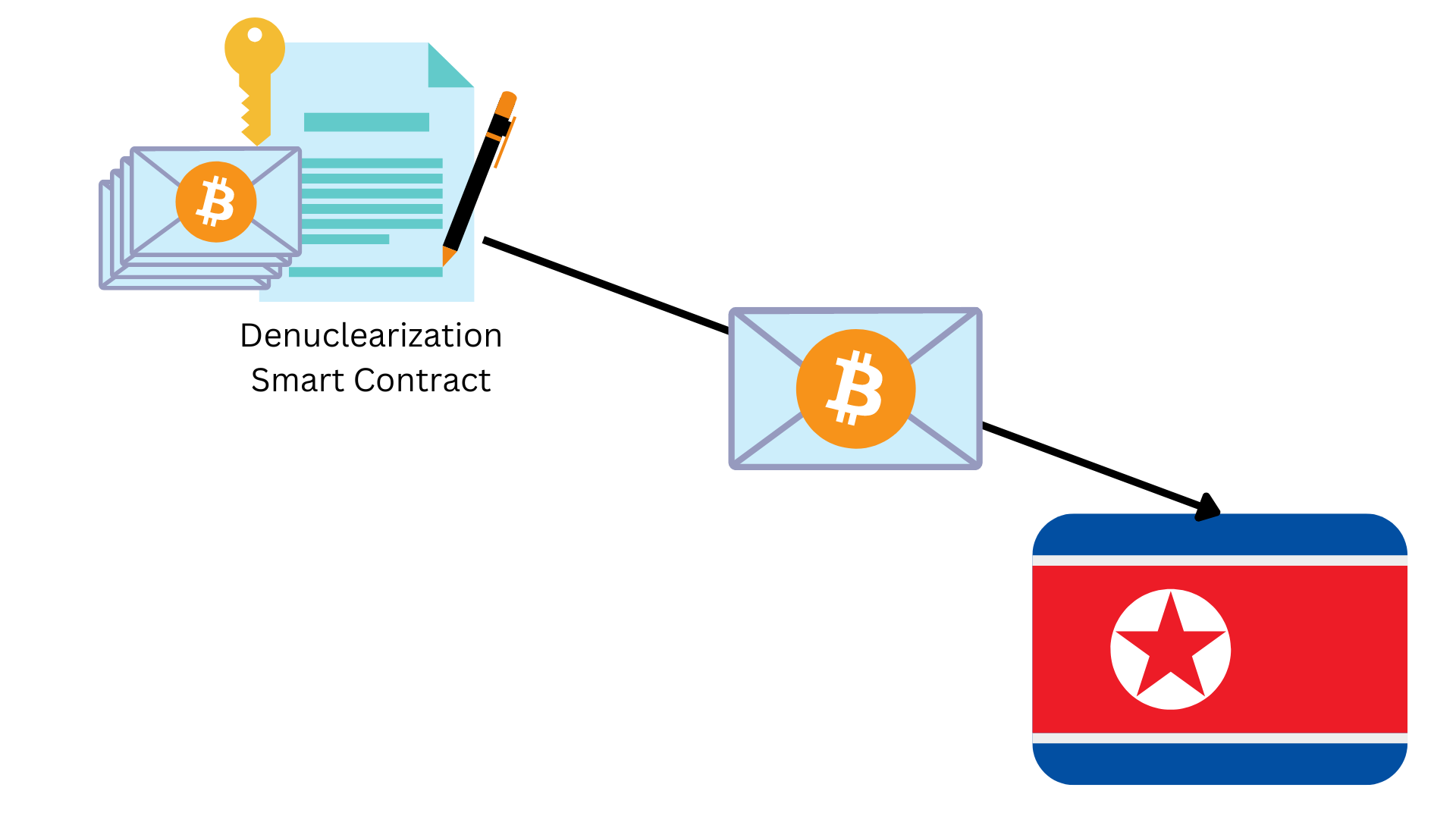
In return, the smart contract rewards them with a pre - determined amount of Bitcoin. The reward is guaranteed because of the smart contract blockchain’s code immutability property.
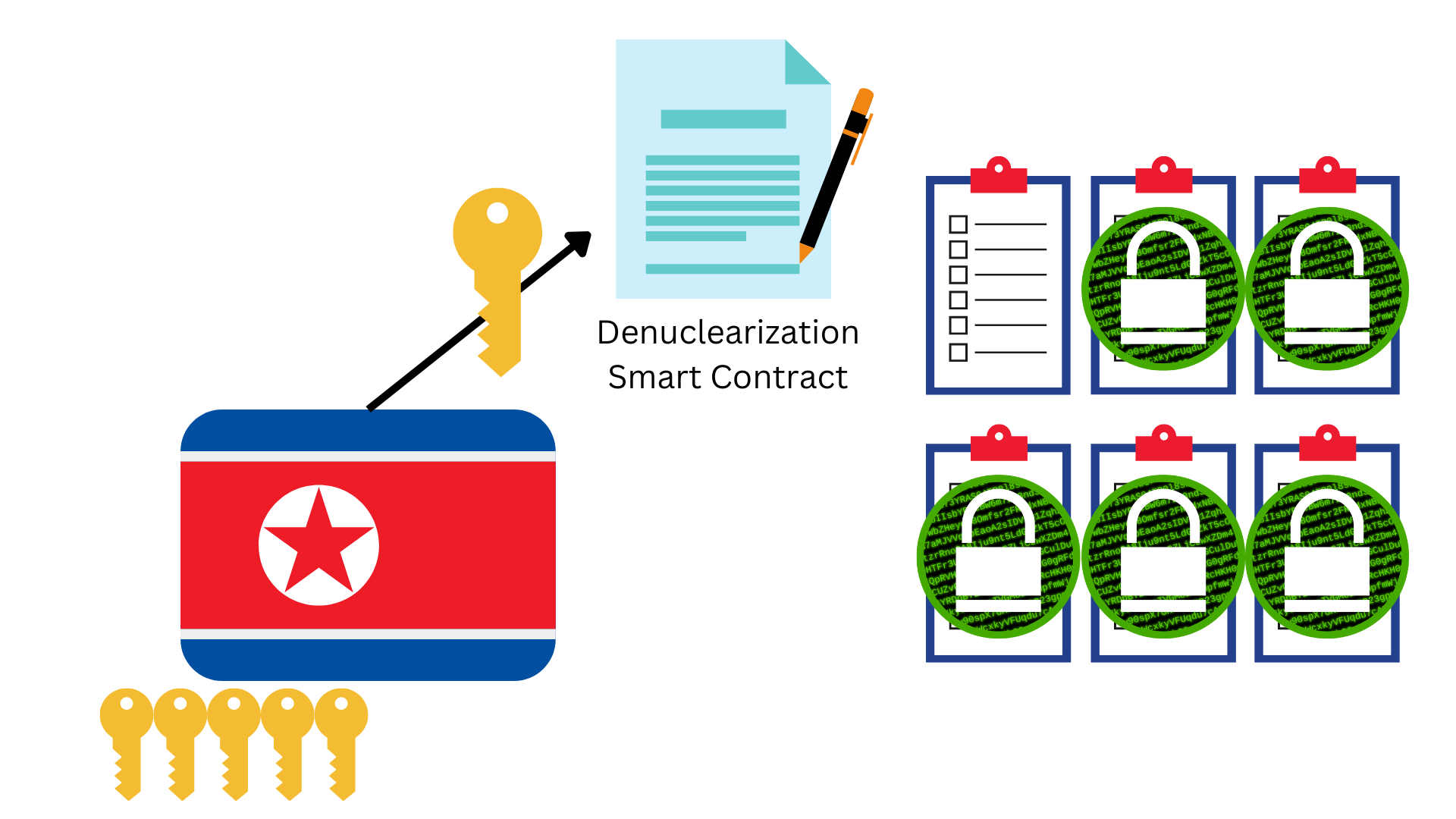
At a reasonable pace, the DPRK publicly decrypts parts of the nuclear capabilities list by depositing decryption keys into the Denuclearization Smart Contract (thus making the information public),
Part II (issue 2)
Denuclearization is going to be a long process (think 20 - 50+ years)
I’m currently researching democracy (see SCAO). During this research I’m coming to understand what a herculean effort complex social mechanisms such as democracy (and denuclearization) truly require to be effective. Furthermore, this herculean effort needs to remain constantly maintained and developed - almost like sustaining a living organism with food, sleep, exercise and medicine.
In the case of democracy: in order for it to function properly an extensive infrastructure must be built alongside it: quality education, access to quality information, along with various other resources and institutions which stabilize society to the point democracy can function are critically needed. These institutions need time and sustained effort to get built, become effective, and also need to remain continuously maintained and developed as well.
In the case of denuclearization, a similar effort will need to be undertaken. “Institutions” in this case will need to provide adequate security to all parties, as well as economic structures which will incentivize our substantial effort of putting our differences aside worth it.
Despite the truly admirable engagement and denuclearization efforts made so far, based on the sub - quality results we’ve had, I believe denuclearization will take a similarly herculean amount of effort complete with not only a superb incentive structure, but also a good amount of reason, empathy, tolerance, understanding, superb communication, and critically: proper education of the general population, primary decision makers as well as the associated decision making apparatus (media, think tanks, lobbyists etc.) of multiple countries to be truly successful.
Step - by - Step approach Going Beyond Nuclear Weapons
Blockchain oracles
In my opinion, nuclear weapons have proliferated because of complex reasons; fundamentally they seem to originate in fear, in violence, a deep longing for security, justice, peace, independence, self - reliance and most crucially: a yearning for freedom.
Denuclearization will not be possible without solving these fundamental issues, which will take time and effort to achieve. Just as democracy needs strong institutions and societal infrastructure to function properly, so too will denuclearization - whose “main institution” might just be the economy.
We could imagine a relatively simple “action for action” denuclearization smart contract (like in part 1) which might look something like this:
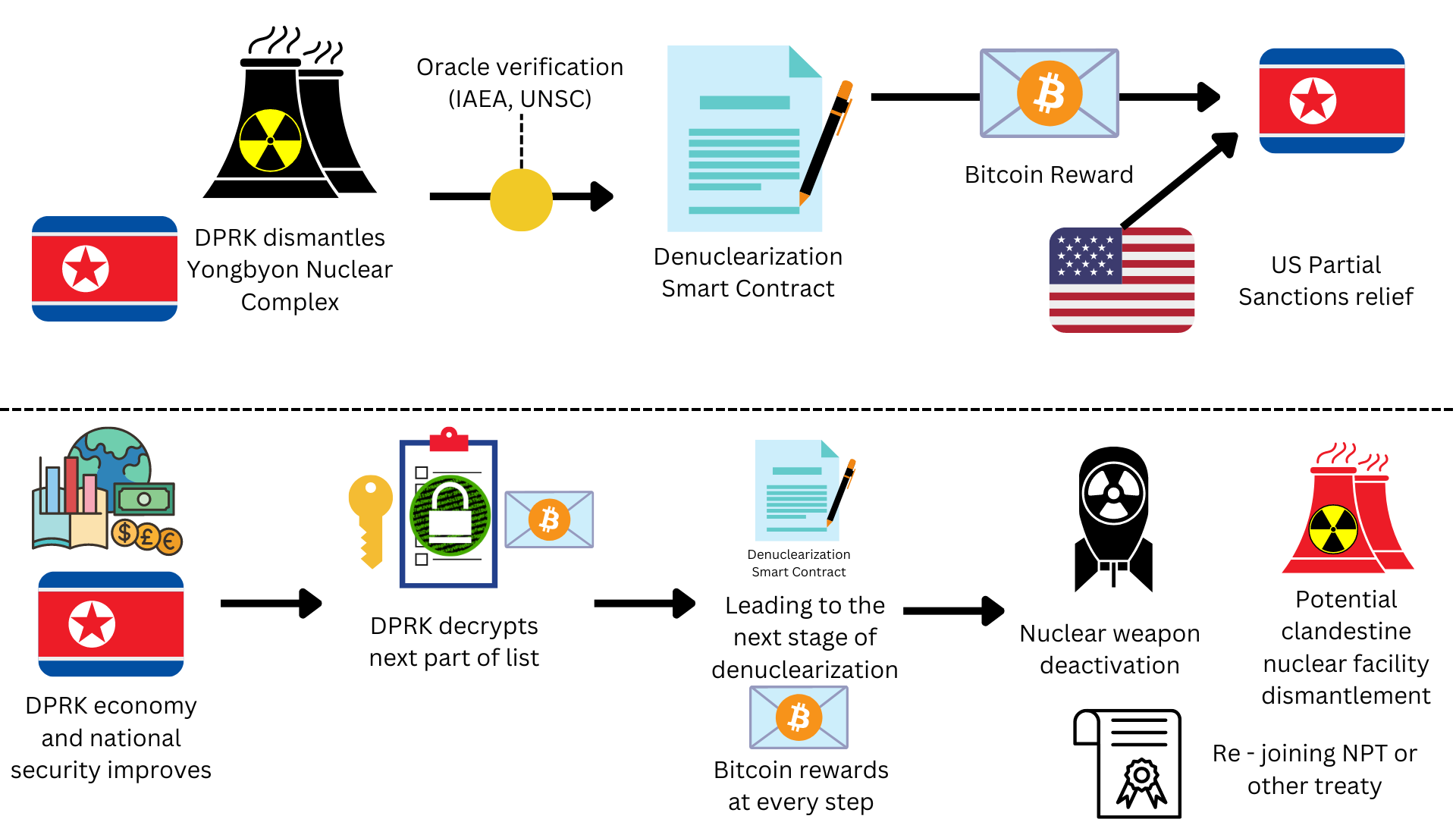
As in part 1, all relevant parties deposit wrapped / bridged Bitcoin into a smart contract. In this example, we introduce a novel concept: the blockchain oracle, which is a technology that provides real world data onto the blockchain. To simplify: imagine the oracle in this scenario as a simple council of trusted, qualified experts (can be entities such as the International Atomic Energy Agency and the United Nations Security Council, or even a direct democracy system), which provides the denuclearization smart contract with the centralized, trust - based “go ahead verification”, that the Bitcoin reward can be released to the DPRK as reward for verifiable denuclearization steps.
Through the help of the oracle, a step - by step smart contract, that rewards all parties could be written in a similar manner to the denuclearization plan compiled by Siegfried S. Hecker, Robert L. Carlin, and Elliot A. Serbin (albeit with a longer time frame).
However, with the introduction of a centralized, trust - based oracle, one could argue we don’t really need a blockchain in this scenario. Also, this denuclearization smart contract design is highly flawed in other ways for example: to make the rewards worthwhile to incentivize the DPRK, a substantial amount of expensive Bitcoin would need to be locked in the smart contract for an immensely long period of time before any results ever occur - this is highly unrealistic and unlikely to be effective.
Complex, Programmable Financial Instruments
Instead of the above simple scenario, we will look to mathematics, and borrow the concept of imaginary numbers - only that in our case, our “imagnary numbers” might one day indeed exist in the real world !
Lets exercise our brains by imagining, envisioning and innovating novel “complex, programmable financial instruments” which can be programmatically tied with or derived from: money, the economy and private financial markets in a globally interlinked manner, erecting a “decentralized financial mycelium.”
I ran out of time to fully explore this part of the geopolitical application (for which I also require further education). In addition, I also sadly had even less time to find an effective way to properly explain and present this vision (it is quite complex - the technology is still so new, and we don’t yet fully understand its full capabilities). A detailed, full explanation will be made at another time, on another page. When you continue, please remember that this concept is released prematurely, is under-developed, under - thought through and potentially flawed. I’ll try my best to explain the vision here with a few examples to make it easier to imagine what these “complex, programmable financial instruments” might look like:
There are many examples, but 2 of the simplest ways to imagine “complex, programmable financial instruments” are:
1)
A unit of money which does not yet exist, but will exist in the future (as part of a Keynesian central bank controlled inflationary fiat monetary policy trajectory, fractional reserve banking, or through mining a cryptocurrency).
2)
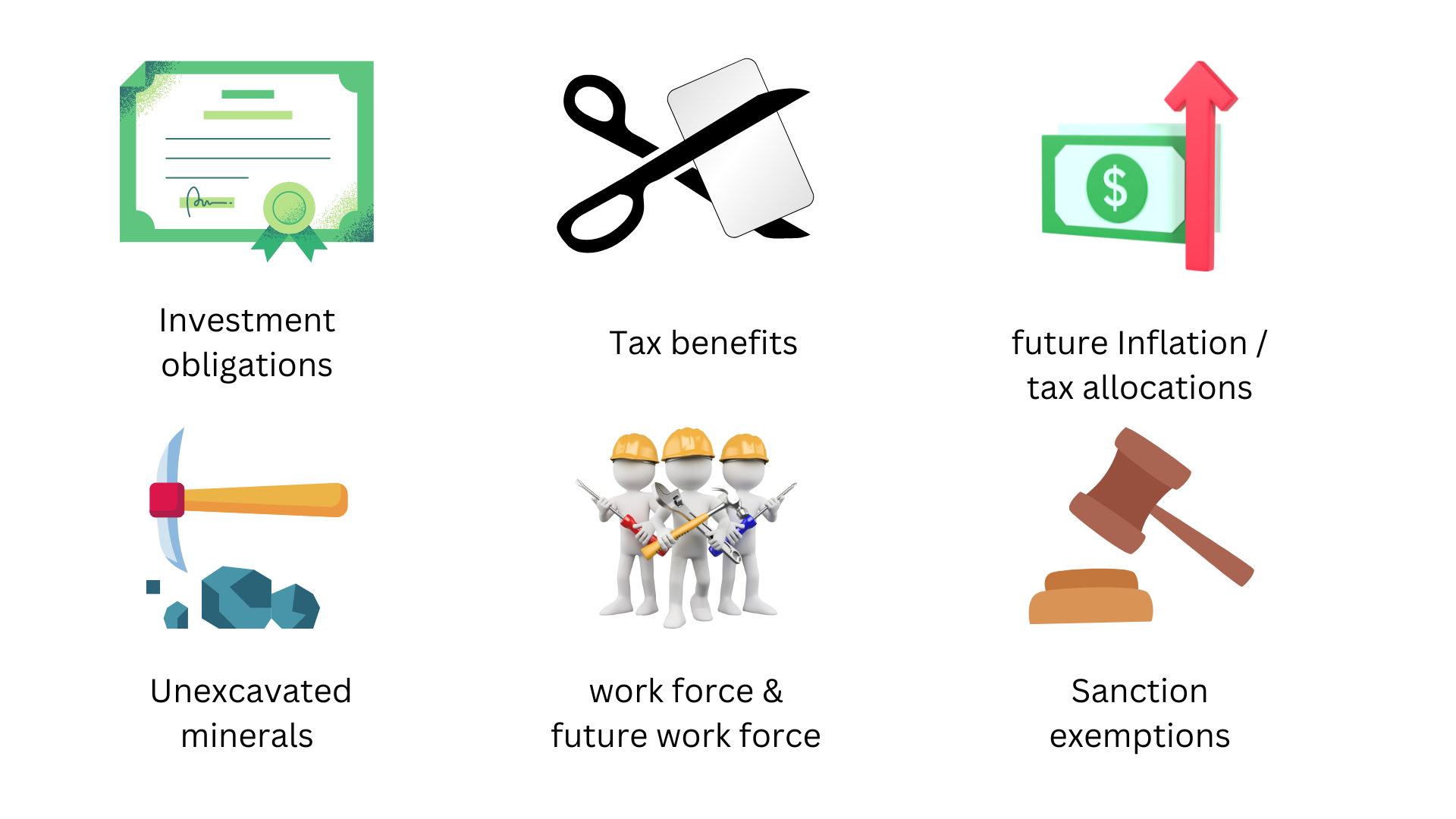
An asset that exists in the real world, but is not yet utilized. For example: A) a work force that is still in school, B) an unexcavated resource: for example, a unit of valuable minerals that we know is there in approximate quantity, but has not yet been excavated (it will be excavated in the future).
The participating countries could stake the following tokenized “complex, programmable financial instruments” into the denuclearization smart contract:
investment commitments,
loan options & future loan options,
future interest,
financial aid (including financing projects like Tomorrow Tree),
future tax benefits,
technology transfers,
future market or resource rights,
future sanctions exemptions.
(to name a few possibilities).
These “complex, programmable financial instruments“ could be programmed in an “if this then that” manner providing a long term, highly flexible, pool of multiple choices / courses of action between 2 or more parties, which together construct a progressive tree of future options to choose from in a flexible, multilateral way allowing for deep economic integration which is natively tied to long term peace.
Crucial to understand: with this approach, all parties economically benefit, including the United States and other former adversaries which now open new markets, open new supply sources, potentially reserve resource rights and other mutually beneficial economic activity.
An example Progressive Tree of Future Options:
Step 1: Tokenization
Step 2: the Progressive Tree of Future Options { if this, then that }
Global overview (whole 50+ year tree):
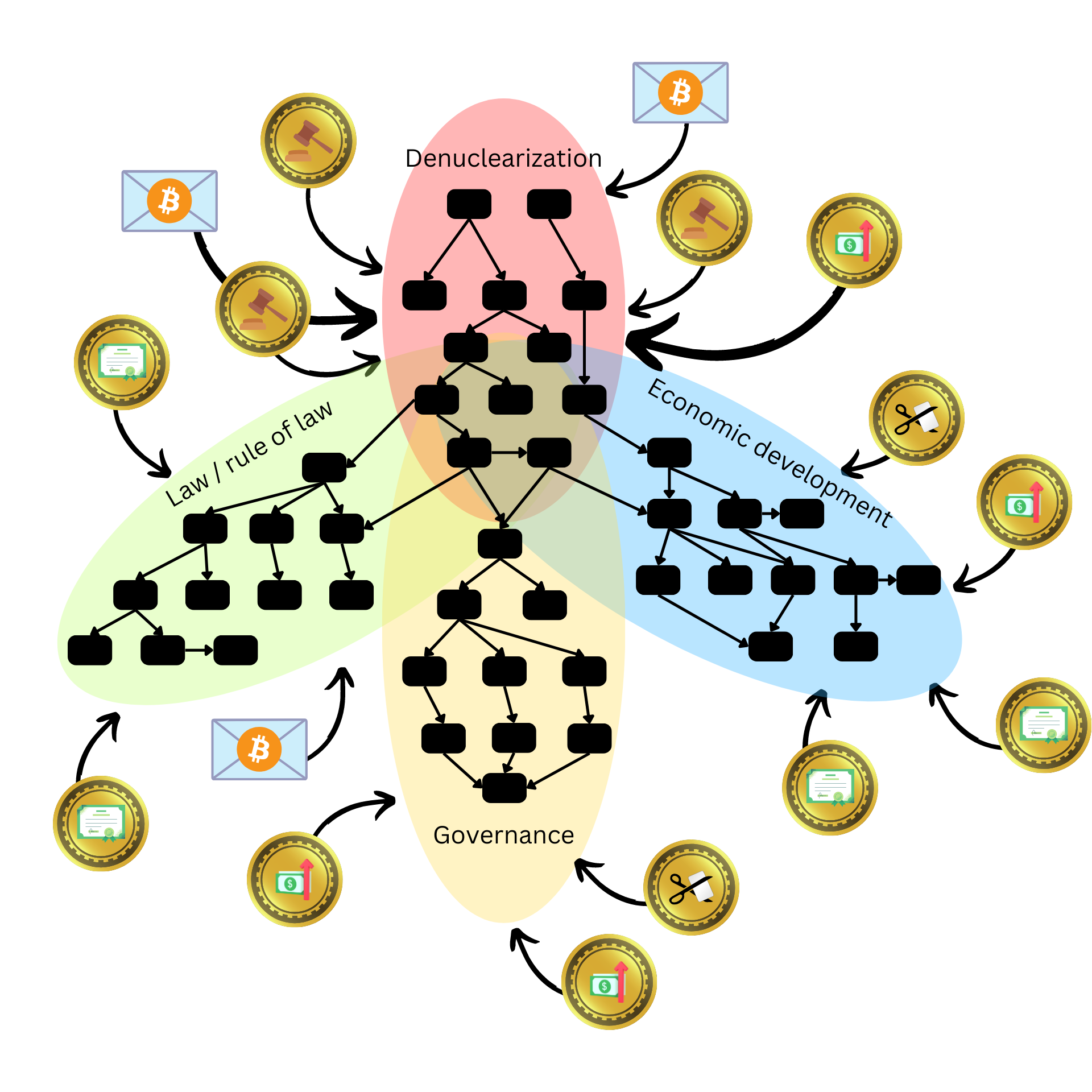
Example: detailed denuclearization branch (for illustrative purposes only)
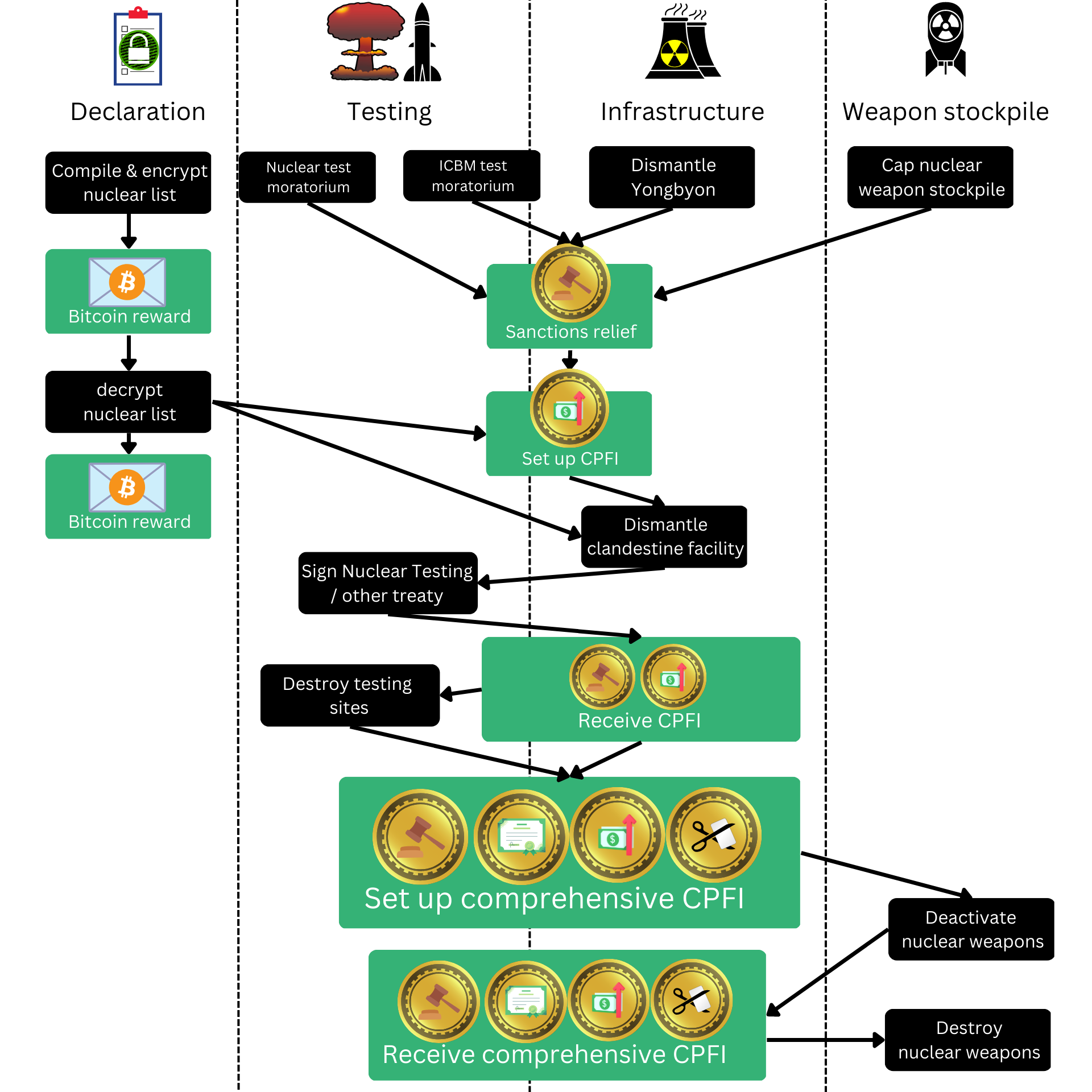
In the above progressive tree of options, each action or combination of actions (depends on how it’s programmed) receives an appropriate reward and a predictable future course to incentivize sustained development of peace and economic collaboration at a safe, reasonable pace.
Sanctions Relief NFTs
NFTs have a really bad reputation due to the abundance of scams, misrepresented and over - hyped use case utility, however, these are not the scammy - type NFTs you may have in your mind, but more similar to technological utility NFTs (for an example see how Open Forest Protocol uses NFT technology here.
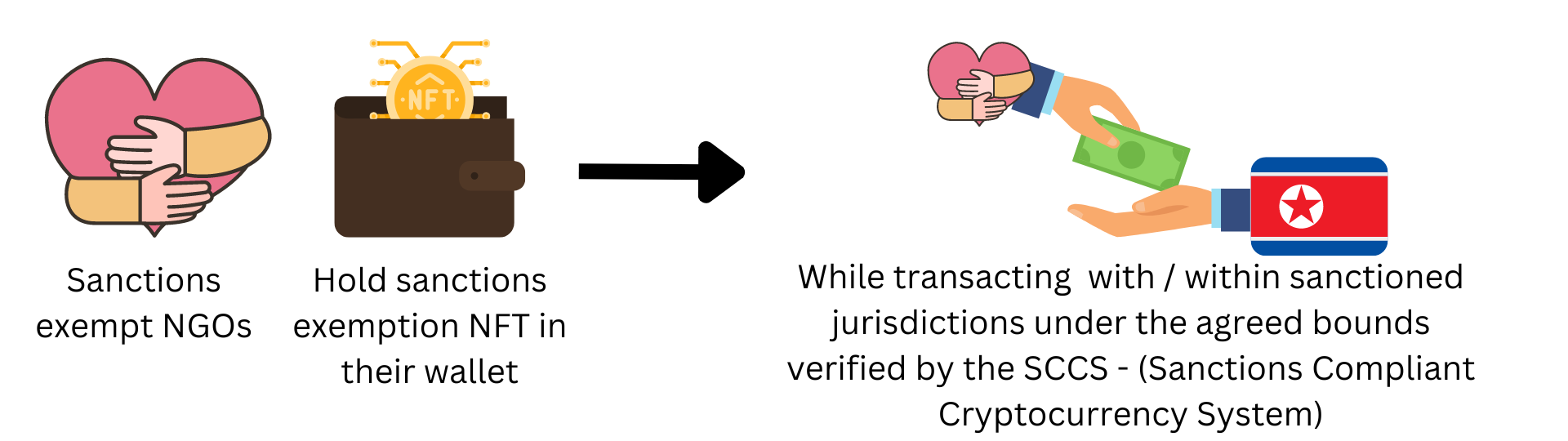
Sanctions Relief NFTs are individually assigned tokens with individually identifiable information e.g. serial numbers. Sanctions exempt entities could use these as a counteirfeit - proof permission badge which programmatically enables financial transactions with sanctioned jurisdictions by holding them in their wallets.
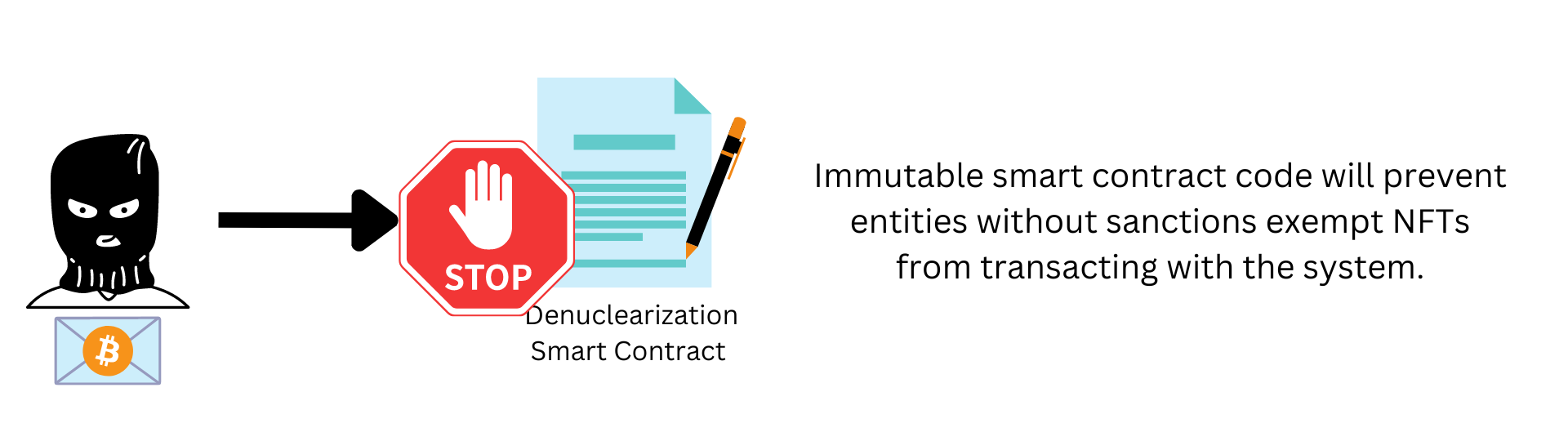
Smart contracts, or private / state entities can check for the presence of these NFTs in a wallet / smart contract and automatically allow individual sanctions - compliant cryptocurrency transactions which would otherwise be blocked by immutable blockchain code.
Sanctions Compliance NFTs could theoretically be used in combination with Tomorrow Tree’s hypothetical Sanctions Compliant Cryptocurrency System.
Lets look at how they work:
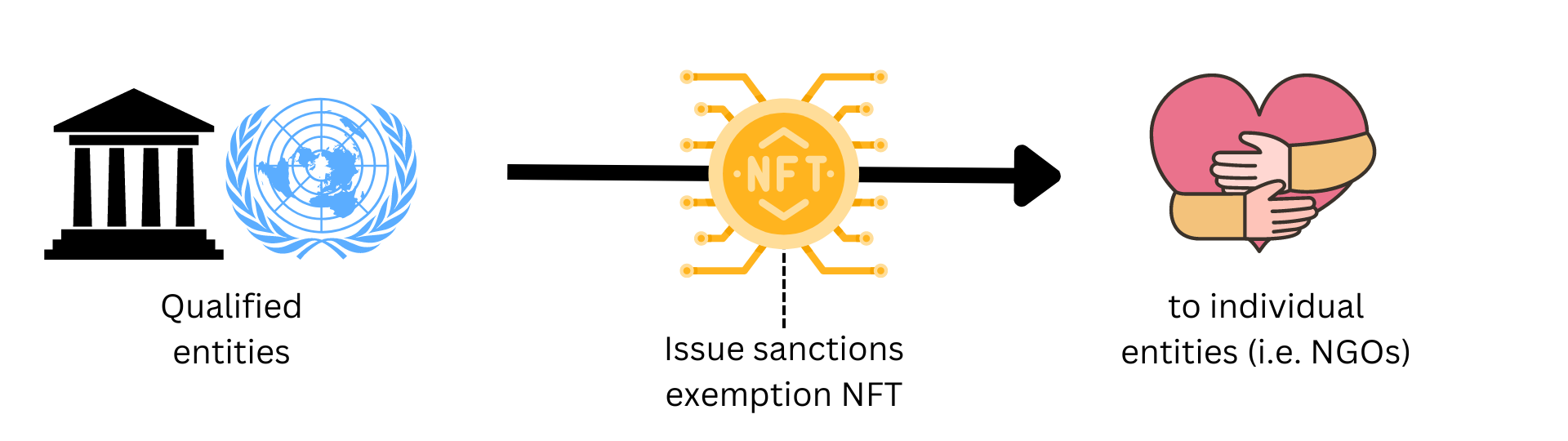
Qualified entities such as the United Nations or individual Westphalian Nation State governments issue sanctions exemption Non Fungible Tokens (NFTs) after approving a complex sanctions compliant long term business / operations plan done in conjunction with the SCCS (Sanctions Compliant Cryptocurrency System).
Counterarguments to Blockchain use in Geopolitics
Blockchain technology is controversial. Most prominently its critics point out the technology is a solution looking for a problem; that globally the blockchain does not add any value in finding solutions to existing problems.
For a more complete overview of various criticisms, see:
Blockchains are not Decentralized and are not Immutable
Molly White´s “Blockchain-based systems are not what they say they are”
Also see: the censorship methods used during Bitcoin´s Block Wars
This section will be further completed at a later time.
This problem might be minimized with the help of cross - blockchain solution Axelar allowing more options to achieve the sufficient decentralization required for geopolitical use - cases.
Smart Contracts Vulnerabilities
As a new technology, smart contracts have not yet been adequately battle tested for security. Smart contract exploits are wrecking havoc on DeFi users: Web 3 is Going Just Great
This section will be further completed at a later time.
Quantum Computers Breaking Encryption
As of now I do not possess deep knowledge on this topic, other than having watched this Veritasium video:
How Quantum Computers Break the Internet… Starting Now
This section will be further completed at a later time.
Nuclear NFTs
😁 Help support my work 😁
I´ll be experimenting with multi - chain programming and NFT utility in governance using cross chain solution Axelar by making simple multi - chain NFTs for my friends
and hopefully build a larger anti - nuclear war community
( know that if there continues to be a lack of support I’ll give up on this project though ).
Sign up below to be notified when more information is available:
Comments, Feedback
Thank you for your attention 💚
These concepts are still at a very early stage with little real world experimentation having been done at this point due to a lack of resources. If this topic interests you I suggest checking back for updates regularly.
Perhaps more methods, arguments, counterarguments, scrutiny or criticism will surface ? I’d really appreciate feedback, comments, observations etc. if you can ( thank you ❤ )
Also see my other blockchain writing found in content. Lastly, hope you have a great day ! :)