Introduction to the
SCAO’s Liquid Democracy Governance System
written and designed by Klemen Skornisek
Original post: Nov 8th 2022
Last edit: Apr 29th 2023
A big update is planned shortly
Liquid Democracy Governance
Introduction
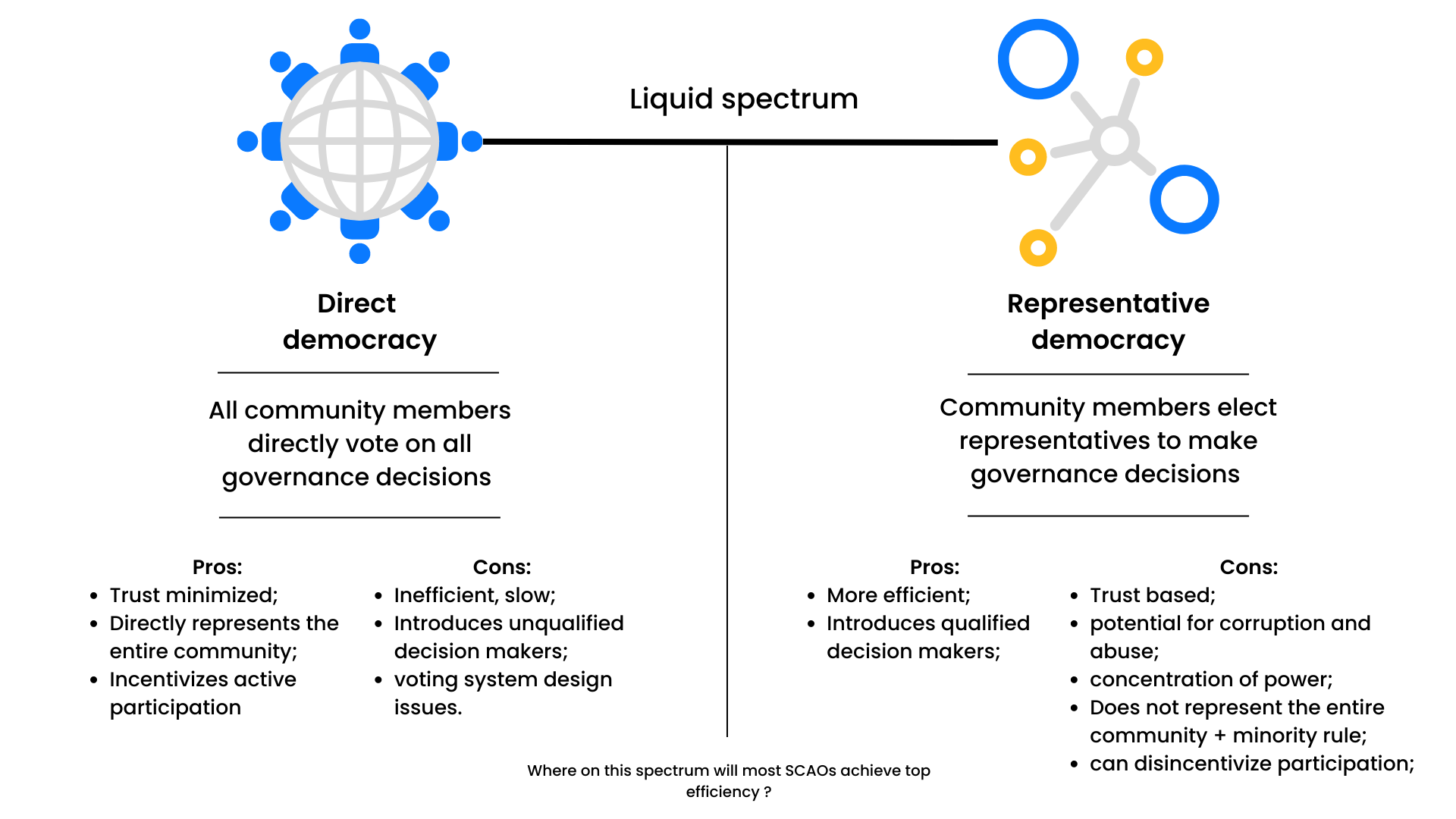
While specific governance designs will vary between each individual SCAO, the working hypothesis is that a majority of them will achieve peak efficiency somewhere along the liquid democracy spectrum. A liquid democracy system combines elements of both direct and representative democracies, which if designed right ensures the political process is open to everyone, but also provides certain protections from voters who lack the sufficient knowledge and expertise to make certain key decisions.
Governance is not an easy topic. Much debate, real world experimentation and constant scrutiny is necessary.
The governance section will be updated and better structured over time, but for now I suggest you read the documentation that was created as a result of the 2022 Polygon x Encode hackathon:
During the hackathon we looked at Porto Alegre’s Participatory Budget Process and learned that a complex adjacent infrastructure is crucial to the proper functioning of a participatory democracy.
An uniformed democracy is a dangerous democracy. Voter participation education, infrastructure and incentive scheme are the necessary requirements to achieving outperformance.
A Universal Basic Income ( UBI ) paid in return for democratic participation may be worthwhile looking into (see my rudimentary UBI thoughts here).
Other prerequisite resources:
To best understand what the governance requirements of a SCAO are, let’s look at:
An Example of SCAO Network Governance
Multiple worldwide companies are connected in a SCAO providing integrated solar panel solutions worldwide. Alone, each of the companies connected into a SCAO cannot afford to erect common infrastructure such as for example: a Solar Fence factory in the United States. The erection of an American factory would potentially make the whole network more profitable by cutting transcontinental Solar Fence transportation costs for EPCs. Even though this would cut transportation company’s revenues (and they might in fact campaign against this decision), the negative effects would be lessened, because the transportation company’s hard asset token value would grow as a result from the better efficiency decision.
SCAOs thus lessen the negative effects of zero - sum decisions for network participants and incentivize always finding the best option.
Even though each individual SCAO will have different custom governance structures, lets look at this simple hypothetical Solar Integrated SCAO governance example case and its process:
A few further observations:
Some SCAOs may need to adopt a “constitution” of sorts defining exactly what thresholds must be set before a proposal or vote is cast, and perhaps compartmentalize certain governance processes similarly to how a case moves through a judicial system in nation states based on jurisdiction or importance.
Notice that the original Slovenian startup company does not get violently muscled out of the SCAO, and in case it happens it has its hard asset tokens as a sort of fail-safe. The need for inefficient market protection / tariffs, purging or violent takeovers is lessened and the economic laws of specialization and free market forces prevail; everyone is contributing to the same cause and efficiency is in everyone’s interest.
Problems typical to democracies such as stalemate, censorship etc. may never be eliminated fully, but at least it’s a step forward when comparing to a traditional dictatorial corporation that engages in central planning, central execution, where speaking out may cost someone their job, or in cases where it’s more economically logical for the employee to keep the idea for themselves and break away as a rival company etc.
Over time the network keeps expanding in a mathematically chaotic way. Internal infrastructure is established, which eventually goes beyond the original company’s expertise or predictions hopefully outperforming any central planning ( think Zuckerberg’s metaverse decision ). It is reasonable to envision the SCAO would even be able to attract and support scientific researchers independently innovating new technologies supported by the SCAOs common infrastructure.
Since everyone is independent and safer in a democratic environment in which they have a real stake in, everyone is incentivized to not only operate at max productivity, but also to innovate on how to maximize network value, profit and minimize expenses.
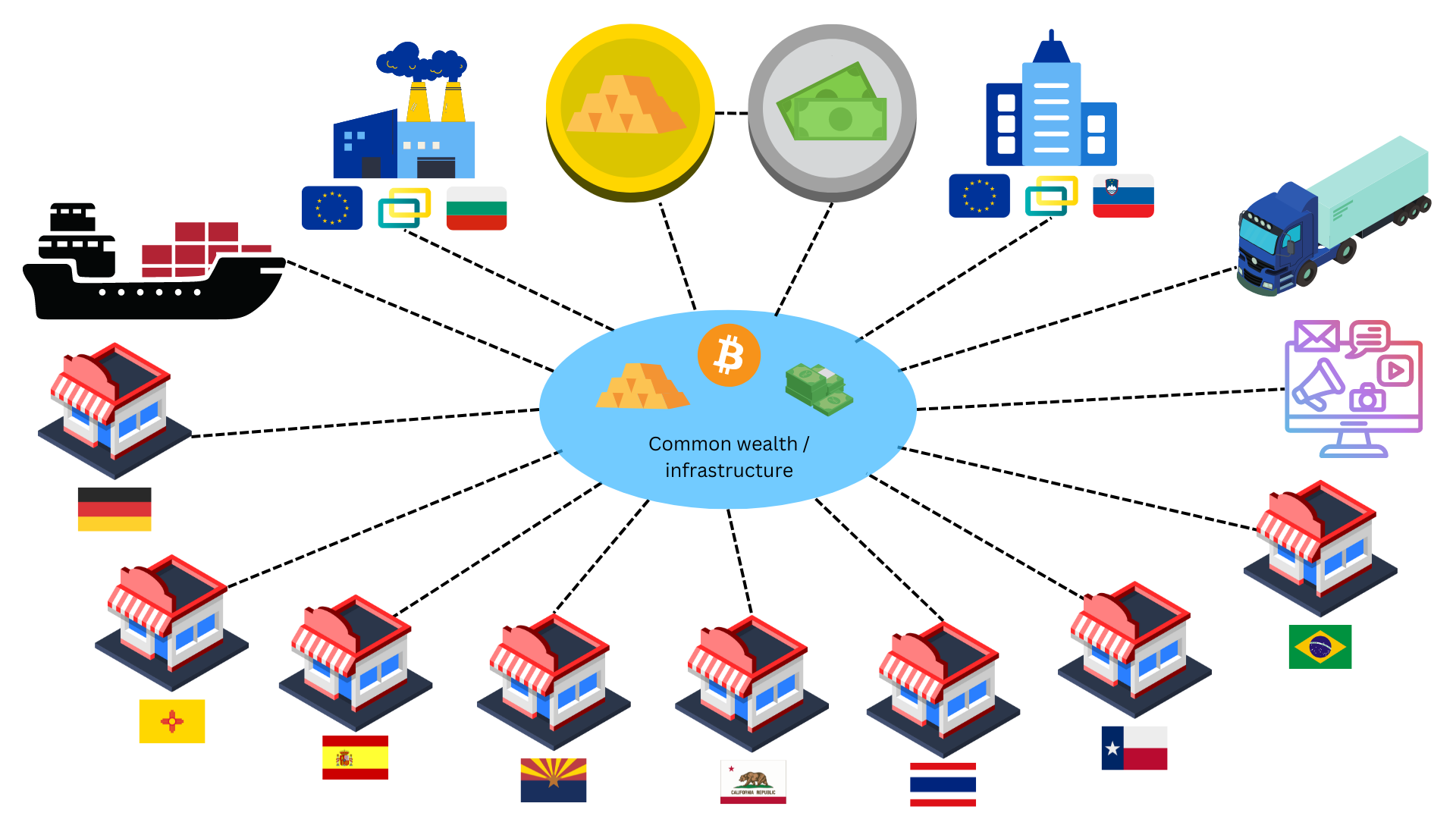


Every custom time period a Porto Alegre inspired communal wealth / infrastructure treasury budget and executive plans are proposed, discussed voted on and set by the entire SCAO network in an efficient custom process ensuring adequate participation rates.
An American entity has the idea that building a US Solar Fence factory would make the SCAO more profitable, consequentially rising the HAT price. The entity conducts market research, proposes the plan to the communal governance forum and campaigns for the realization of their plan.
This proposal will lessen the transportation company’s revenue, and they may attempt to prevent the election of the proposal by either arguing against it, or even spreading disinformation - which is why a thorough democracy voting education & infrastructure are crucial to ensure the best outcome.
Hopefully the opposing campaigns create a thorough debate from which the best choice emerges, and is set in the first part of the budgeting process setting the program agenda for the next time period.
The second part of the budgeting process encompasses the execution of the budget accepted in the first part. The execution process may differ from case to case, but for this case trusted qualified representatives may be elected into an executive factory construction committee demonstrating the liquidity of this democracy.


All ideas and data that weren’t elected remain open for further development, and are kept as historical reference points for potential future re - evaluation.

Final Remarks
Thank you for your attention 💚
Even though I have been designing a novel governance system for Tomorrow Tree Institute since 2019 it’s still at a very early stage with little real world experimentation having been done at this point due to a lack of resources.
If this topic interests you I suggest checking back for updates regularly. When certain counterarguments surface I will list them here; for example: even though the larger SCAO is governed democratically, individual entities connected into the SCAO retain their law mandated traditional dictatorial structures. My current approach to this is to think of the SCAO as a nation state and individual entities as the nation state’s individual households. Many households (say patriarchal or matriarchal families) are often structured as a “dictatorship” (where parents dictate the actions of their children), yet the nation state itself is considered democratic regardless. It is yet to be seen whether regulators would consider this properly decentralized or whether securities laws would apply… ?
Perhaps more counterarguments or criticism will surface ? Will the SCAO actually outperform a traditional multinational & multi - sectoral conglomerate ? We’ll need to test it out.
Lastly, I’d really appreciate feedback, comments, observations etc. if you can ( thank you ❤ ):