
A Valuable Lesson From 판문점
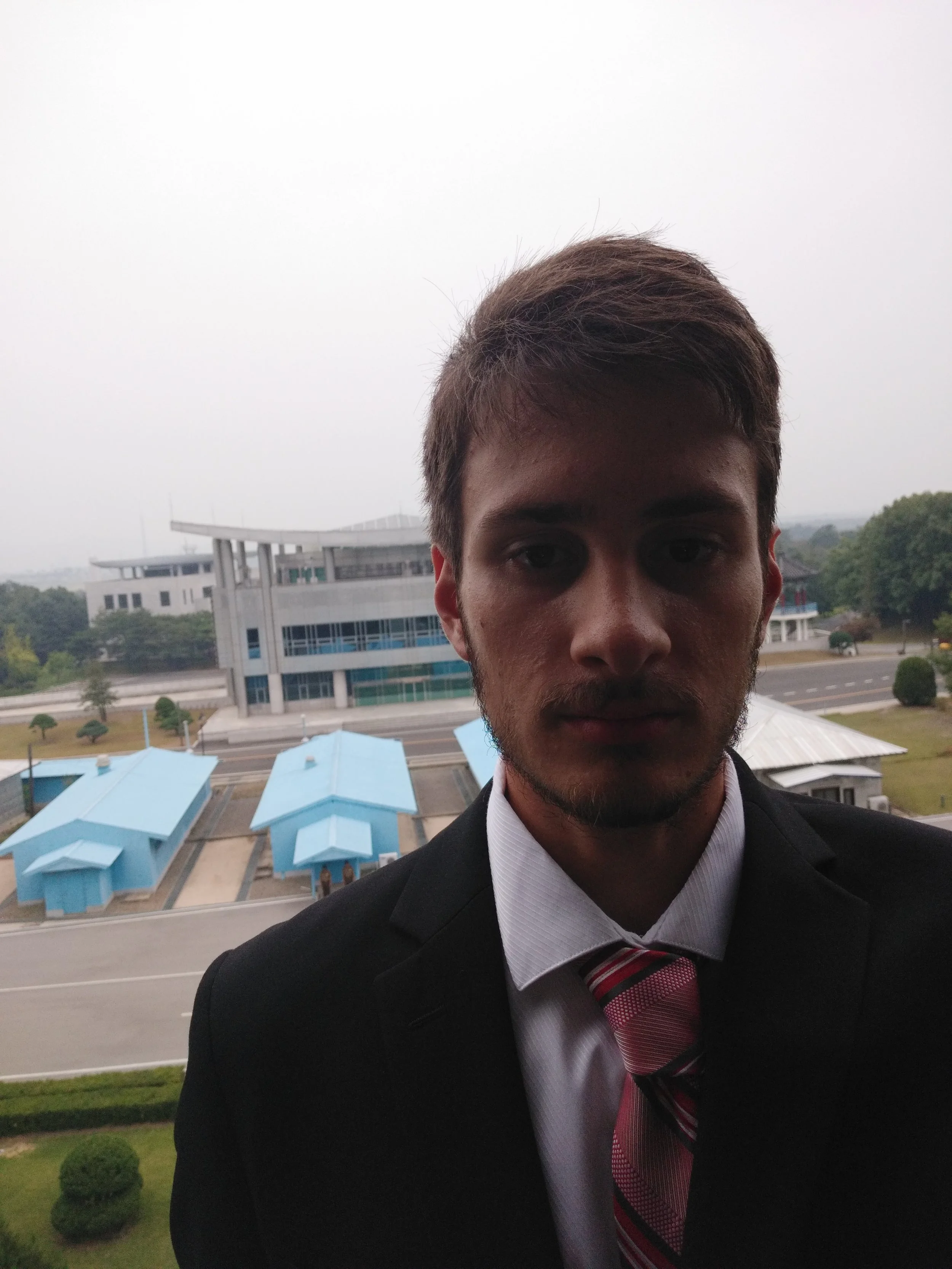
Klemen Skornisek at Panmunjom
Executive Summary
(TL;DR)
It is not enough to strive for doing good alone,
it is crucial to concurrently avoid doing harm.
Few words of advice:
If at all possible, avoid ignorance even if it means the end of your own happiness.
If you find yourself in a challenging situation, but you are not momentarily being chased by rabid wolves or similar: do not panic, calm down, you are safe and you will be safer if you think clearly and calmly.
Doing good is not enough, we must also be mindful to avoid causing harm.
In light of recent events I feel compelled to share a what I hope might be a helpful personal story from my September 10th 2017 visit to Panmunjom (판문점) - the location where the Inter - Korean Armistice Agreement was signed on July 27th 1953.
Ignorance
Looking back: when I traveled to Korea for the first time, probably like many of you, I had been almost completely ignorant of the reality of the situation there, despite the thermonuclear weapon test conducted 7 days earlier.
It’s one thing to read on Wikipedia that the Korean War never ended, but that information feels dead and dangerously distant in comparison to witnessing the actual, live reality. Too many people today are still completely - one could even argue delusionally oblivious to the seriousness of the on - the - ground realities of war.
Panic
Visiting any Korea, you are visiting a war zone, even if it does not truly feel like it. Visiting the inter- Korean demilitarized zone presents an opportunity to catch a small glimpse of what war may feel like as on the premises there is a very real danger of getting shot. I can’t tell what exactly triggered it… was it knowing that we could get shot ? Was it knowing that on the other side of the border they were recording us ? Was it the general tenseness of the soldiers ? Of the high alert 분위기 ? I can’t tell… But whatever it was it was rapidly escalating. In the room where the armistice was signed, all of a sudden, and all at once I felt panic. My heart started racing, I started sweating profusely, I stopped paying attention to my surroundings, I stopped thinking clearly and in that intense, childish, momentary madness a thought came: “if I had to run across, could I make it ?”
Savior
The stoicism of the Koreans, along with their justified pent up anger is in my opinion oftentimes dangerously misinterpreted. I always found the people I interacted with to be remarkably emotionally intelligent in addition to being compassionate, reasonably so in their own way. One of our guides whom I would consider to be one of the most impactful people to grace my life recognized something was wrong, came up to me and asked me if I am okay ? Today I am in tears remembering her friendly smiling face, thinking how she lived her entire life under the cloud of this shitty war.
Spring
Hearing her, realizing how I did nothing wrong by coming here, I calmed down. There was no reason to panic, I wasn’t chased by a pack of rabid wolves, there was no immediate danger, there was nothing wrong with visiting Korea, there was no reason to create a situation that could lead to actual danger.
We should always breathe, so that we can believe there is enough room for diplomacy albeit within our world, within our community or within ourselves.
First-Principles-Thinking based Diplomacy should always be the better option to war and I implore those who have the power of ordering diplomacy or war to consider diplomacy until the peaceful solution - which exists - is found.
Look Beyond the Shell
The situation was tense beyond our comprehension, but for the time we enjoyed the rest of the trip. The country was stunningly beautiful, the people were people, there was laughter, there were tears and yes: there was fear. Nowadays I contemplate… fear is a natural reaction to keep us vigilant, we should keep vigilance, just as much as we should avoid panic induced madness.
Clarity
Much later on, when presented with the opportunity only time can grant: the opportunity to confront and dwell on what had happened that year did I truly began to understand how precious and fragile peace is. I ask as I do not know: is it a delusion to believe we can have that again ? Is it a delusion to make it our goal ? Could it even be our necessity for survival considering everything we face together as one ?
In the hindsight brought on by time and first principled thinking, I found myself confronting my own narcissism somewhere along this path. At one point or another, the world will need to confront it as well.
Clinical narcissism is a medical condition every person alive is vulnerable to. Everyone falls somewhere on its spectrum, with most of us at risk of sliding further to the point of no return, or having the opportunity to return towards rationality.
Dr. Ramani describes confronting clinical narcissism like pulling on a rubber band.
You need force to pull it apart. If you stop pulling it, it reverts back to the original state. If you pull too hard, it may break. If you let go, it might fly out of your hands.
Pulling it is thankless work, and perhaps we’d even in our ignorance like to lie to ourselves: pointless.
But it isn’t, and we must pull.
Calmly, without doing any harm.